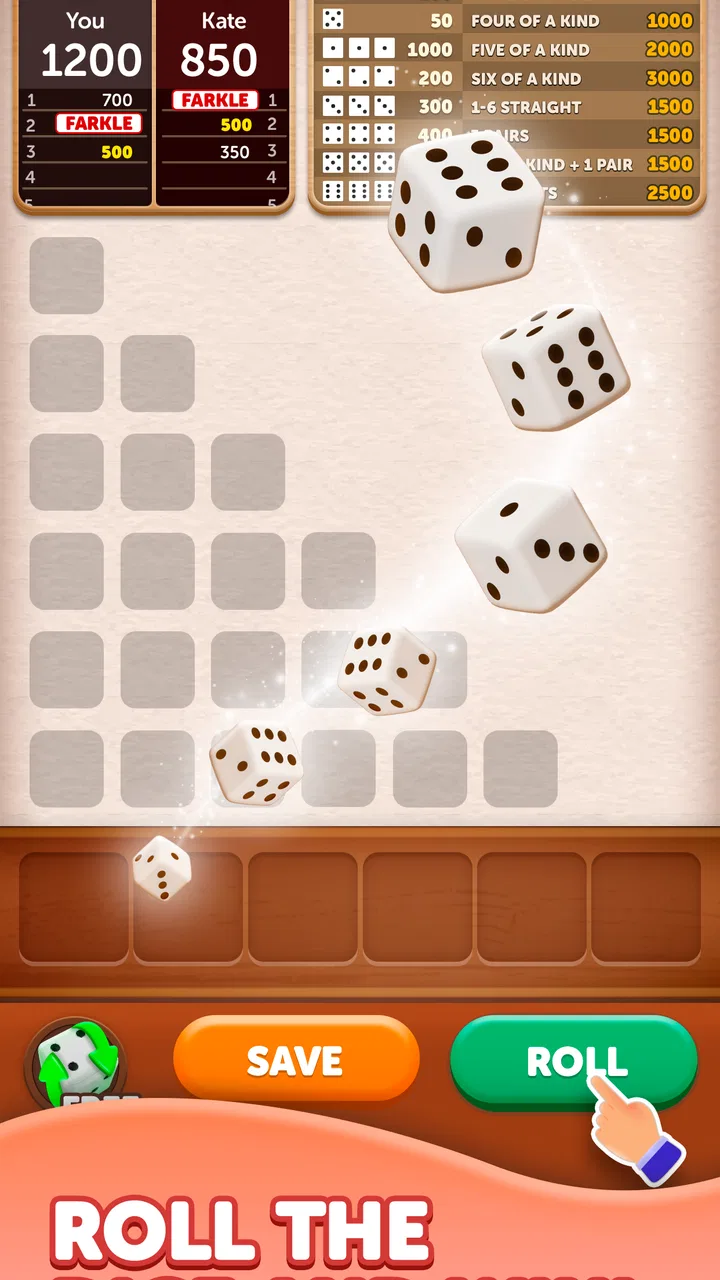
Farkle Dice Roll
- 4.9
- Rating
- 1.00M
- Installs
- Free
- Price

 Analysis by App-foxy
I like board games that explain themselves quickly but still leave room for a clever decision, and Farkle Dice Roll fits that mood well. It is a free dice game from FunCraft Games, built around the familiar push-and-pull of taking points now or risking a better result. The first roll is easy to understand, but the interesting part comes immediately afterward: do I bank what I have, or roll again and possibly lose the turn?
That simple question gives the game its personality. I can open it for a short break, make a few decisions, and stop without needing a long tutorial or a complicated setup. At the same time, a lucky roll can make me stay for another round because the game creates a clear chain of action, feedback, reward, and reset. It is not trying to be a deep strategy board game, and that is important to understand before downloading it. Its appeal is the quick tension between caution and greed.
How the first roll turns into a decision
The game presents itself as a board-style dice experience, but the real hook is not simply throwing dice. The first action gives me a result to evaluate. I look at what can score, decide whether the current total is worth protecting, and then choose between ending the turn or pressing my luck. That makes every roll feel like a small conversation with myself: take the safe reward, or chase the more satisfying one?
You May Also Like

 Blood Strike: 2.5 Anniversary
Blood Strike’s Loadouts Turn Every Drop Into a Tactical Gamble
A close look at Blood Strike’s custom loadouts: how fast access to signature weapons reshapes its battle royale rhythm, rewards preparation, and narrows the gap between fights.

 Pandora - Music & Podcasts
Pandora’s Music Is Easy to Start, but Harder to Recover
Pandora’s strength is its low-effort path from a seed to a station. Its weak spot is how much confidence it asks you to place in connection, setup, and quiet recovery.

 8 Ball Pool
 Is Built on Rivalries, Rematches, and Routine
A close look at the rivalries, rematches, shared routines, and unanswered safety questions that turn a quick pool match into a persistent mobile community.

 Samsung Music
’s Quiet Strength Is Playing What You Already Own
Its reach comes less from spectacle than from dependable access to a personal library. That simplicity is both the app’s strongest retention engine and its ceiling.

 AccuWeather: Weather Radar
AccuWeather Review: A Quick, Clear Forecast for Everyday Decisions
For everyday plans, the best forecast is the one you can understand quickly. AccuWeather makes rain timing, radar, and local conditions easy to act on, with a few trade-offs.

 Hill Climb Racing
Why Hill Climb Racing Still Turns Crashes Into One More Run
A tiny car, a bumpy hill and one more upgrade: Hill Climb Racing keeps resurfacing because its simple chaos makes every near-miss feel personal.
More From Our News Desk



This is where the game is more engaging than a completely passive dice simulator. Luck controls the result, but I still control the moment when risk becomes unreasonable. A cautious player can lock in smaller gains, while an aggressive player can keep rolling when the potential reward seems worth the danger. Neither approach is automatically correct, which gives even a short session a little personal strategy.
I found the opening moments especially suitable for casual play. If I have only a few minutes, I do not need to prepare a board, invite several people, or remember a large ruleset. I can begin with the dice and make a decision almost immediately. That quick start is one of the strongest reasons to choose this over a more elaborate digital board game.
New players should not expect the depth of a traditional strategy title with multiple pieces, long-term planning, or a large map. The decisions here are narrower and more frequent. The challenge comes from judging risk at the right time, not from building a complex plan several turns ahead. For me, that makes it approachable, though players who want deep tactical variety may find the central choice repetitive after extended play.
Why the risk feels personal
The best part of the first action is that the game makes a small score feel meaningful. When I already have something worth keeping, another roll is no longer just another tap. It becomes a decision with a visible downside. That immediate risk gives the dice emotional weight without requiring dramatic presentation or a complicated story.
A useful way to play is to decide what kind of session I want before starting. If I am relaxing, I can treat the game as a light luck-based pastime and accept occasional bad turns. If I am trying to improve my results, I can pay attention to the moments when I tend to continue too long. That self-awareness matters more than searching for a perfect strategy, because the game’s uncertainty is part of its design.
There is also a practical lesson for beginners: do not measure a turn only by its possible maximum. A smaller secured score can be more valuable than an exciting but fragile possibility. The game does not need to tell me this directly; the repeated consequence of overreaching teaches it naturally. That is one of the few genuinely strategic insights hidden inside an otherwise simple dice loop.
The feedback rhythm keeps a short session moving
After each action, the game gives me a quick answer: the roll helped, the roll changed the situation, or the risk did not pay off. That feedback rhythm is what keeps the experience from feeling like a static board. I am constantly updating my decision instead of waiting through long animations or managing several unrelated systems.
Good dice games depend on clear feedback, because the player needs to understand why a turn feels successful or disappointing. In this game, the satisfaction comes from seeing a promising roll become a larger total, while the frustration comes from losing momentum after taking one chance too many. The contrast makes the next turn tempting. Even a failed attempt can leave me thinking that the next roll might go differently.
The loop is particularly effective when I play in short bursts. A single turn has a recognizable shape: roll, inspect, choose, and accept the result. That structure works while waiting for an appointment, during a commute break, or at the end of the day when I want something interactive but not demanding. I do not need to reserve a long block of time to enjoy the main mechanic.
On the other hand, the same rhythm can become predictable if I expect constant novelty. The game’s appeal is built around repeated risk decisions, so it is not the right choice for someone who needs new puzzles, characters, or mechanics every few minutes. I would choose a more varied board game for a longer focused session, especially if I wanted exploration or a campaign-like sense of progress.
Where luck helps and where it irritates
Luck is central, not a minor ingredient. A careful decision can still end badly, and a bold decision can suddenly produce a rewarding result. I enjoy that uncertainty when I am playing casually, because it prevents every turn from feeling solved. However, players who prefer outcomes to depend mostly on planning may find the randomness frustrating.
The fairest way to judge a bad roll is to separate the decision from the result. If I took a sensible risk and lost, that does not necessarily mean the choice was poor. If I repeatedly chase unlikely outcomes because one lucky turn worked earlier, the problem is probably my judgment rather than the dice. Thinking this way makes the game less irritating and gives the risk system more meaning.
One non-obvious strength is how easily the game can become a test of self-control. The most memorable moments are not always the biggest totals. Sometimes they are the turns where I stop at the right time, even though another roll looks attractive. That makes the experience useful for players who enjoy small moments of judgment rather than only spectacular victories.
The reward is the feeling of having pushed luck correctly
The reward structure works because it arrives in two forms. There is the immediate pleasure of improving a turn, and there is the satisfaction of banking a result before the dice take it away. Those rewards are different: one encourages ambition, while the other confirms restraint. The game stays interesting because I need both instincts.
I also like that the reward is understandable without a large amount of explanation. I can see whether a decision improved my position, and I can connect the outcome to the choice I just made. That clarity makes it accessible to people who do not normally play board games on a phone. The game’s Everyone content rating also makes its basic presentation suitable for a broad audience, although younger players may still need help understanding the risk of continuing a turn.
There is a social use case here, even when I am playing alone. I can hand the phone to a friend and explain the central choice quickly, then compare how each of us handles risk. It works well as a conversation game because the rules are light enough to discuss while playing. It is less suitable for a group looking for a long shared board experience with negotiation, hidden information, or a large number of player roles.
The game is free to download, which lowers the barrier to trying it. Optional in-app purchases range from $0.99 to $49.99 per item, so I would advise checking the purchase flow carefully if a child uses the device or if I am trying to keep the game completely cost-free. The free entry is appealing, but the presence of optional spending means I would not treat it as automatically free of financial considerations.
How I would use the reward loop
My preferred approach is to set a personal stopping rule before the turn becomes exciting. For example, I might decide that a modest result is enough when I am only playing casually, while allowing more risk when I am deliberately practicing judgment. This prevents the emotional high of a good roll from making every later decision impulsive.
Another useful habit is to notice whether I am continuing because the current position is genuinely promising or because I dislike ending on a small gain. Those feelings look similar during play, but they lead to different choices. The first is a calculated risk; the second is usually impatience. That distinction is more helpful than trying to memorize a rigid rule that would ignore the changing situation.
I would also avoid using the game as a serious measure of skill against someone who dislikes randomness. The results can reflect luck as much as decision-making, particularly across short sessions. It is better for friendly competition and personal improvement than for proving who is objectively the stronger strategist.
Why the reset makes another session tempting
Every turn eventually ends, either because I bank the result or because the risk catches up with me. That reset is important. The game does not ask me to carry a complicated state from one moment to the next. Once the turn is over, I get a clean opportunity to apply what I learned, change my level of caution, or simply try again.
This reset gives the game a natural “one more round” quality. A disappointing outcome feels recoverable because the next turn starts with a fresh decision. A successful outcome can be equally tempting because I want to see whether I can repeat the same judgment. The loop does not depend on a long narrative; it depends on the human desire to correct the last choice or recreate a lucky one.
That design is excellent for fragmented time. I can play while waiting for food, take a break between tasks, or use it as a gentle wind-down activity. It is also easy to stop after a turn without feeling that I abandoned a large unfinished objective. Players who prefer games with permanent progress, collection goals, or a strong sense of unlocking new content may find the reset less satisfying.
Device compatibility is another practical consideration. The game requires Android 7.0 or later, and its current version is 1.1.24215. On a compatible Android phone, that makes it a reasonable option for people who do not own the newest device. I would still keep the app updated through the normal store process, since the version number indicates an actively maintained release line rather than an old, abandoned installation.
Who should play and who should skip it
I would recommend it to someone who enjoys quick board games, likes making decisions under uncertainty, and wants a casual activity that can be understood without a long tutorial. It is also a good fit for players who enjoy comparing cautious and aggressive styles, because the central risk decision is clear enough to discuss with friends.
I would be more hesitant to recommend it to a player seeking a substantial solo strategy campaign, a detailed multiplayer board, or a game where careful planning reliably overcomes randomness. The repeated dice loop is the point, not a stepping stone toward a much larger system. If that loop does not sound appealing on its own, additional play time is unlikely to change the experience.
It is also worth considering tolerance for repetition. The game can be relaxing precisely because it repeats a familiar structure, but that can become a limitation for players who need frequent changes in objectives. I would try a few short sessions before spending on any optional item. That gives enough time to decide whether the risk-and-reset rhythm is genuinely enjoyable rather than merely attractive in a quick first impression.
My verdict on the complete dice loop
After spending time with it, I see Farkle Dice Roll as a focused casual board game rather than a broad all-purpose gaming app. Its first action is immediate, its feedback is easy to read, its rewards come from both luck and restraint, and its reset makes another turn feel inviting. That complete loop is the reason it works.
The game has also built a strong audience, with a 4.8 average from around 59 thousand ratings and over 1 million installs. Those figures fit my impression of a title that is easy to pick up and broadly appealing, though popularity does not remove the central trade-off: the experience remains intentionally repetitive and luck-driven.
FunCraft Games has kept the concept approachable, but the simplicity should be viewed honestly. This is not where I would go for a deep tactical board game or a richly changing adventure. I would choose it when I want a compact decision, a little tension, and a clean chance to start again after the last roll.
My final recommendation is positive for casual players. Downloading it costs nothing, the age rating is Everyone, and the core mechanic can provide satisfying short sessions without demanding much attention. I would play with a spending limit in mind because of the optional purchases, and I would skip it if randomness usually overwhelms the fun of decision-making. For the right player, though, the appeal is clear: the next roll always offers a fresh reason to choose between safety and possibility.
FAQs for Farkle Dice Roll
01What is Farkle Dice Roll, and how does it work?
Farkle Dice Roll is a digital version of the classic dice game where players roll six dice to achieve specific combinations and score points. The app provides a user-friendly interface, allowing players to roll dice, tally scores, and compete against friends or AI. It's an engaging way to enjoy a traditional game on your mobile device.
02Is Farkle Dice Roll available for both Android and iOS?
Yes, Farkle Dice Roll is available for download on both Android and iOS platforms. Users can find it on the Google Play Store for Android devices and the Apple App Store for iOS devices. The app is optimized for smartphones and tablets, ensuring a seamless experience across devices.
03Does Farkle Dice Roll offer multiplayer options?
Farkle Dice Roll includes multiplayer options, allowing users to play with friends or family. Players can enjoy local multiplayer modes on the same device or connect with others online. This feature enhances the fun and competitive aspect of the game, making it a great choice for social gaming.
04Are there in-app purchases in Farkle Dice Roll?
Yes, Farkle Dice Roll may include in-app purchases. These can range from removing ads to unlocking additional features or customizations. While the core game is free to play, these purchases can enhance the overall experience. Users should be aware of potential costs before downloading.
05What are the system requirements for Farkle Dice Roll?
Farkle Dice Roll requires a device running Android 5.0 or later for Android users and iOS 10.0 or later for iOS users. It is designed to perform well on both older and newer models, but ensuring your device meets these specifications will provide the best experience. Check your device settings to confirm compatibility.
Pros
- Engaging and easy-to-learn gameplay.
- Colorful graphics enhance user experience.
- Multiple game modes for varied play.
- Quick rounds ideal for busy schedules.
- Offline mode available for travel.
Cons
- Advertisements can be intrusive.
- Limited customization options.
- Occasional connectivity issues.
- Basic tutorial lacks depth.
- In-app purchases can be pricey.

Farkle Dice Roll
Gallery